Short answer: running a local LLM rarely beats a cloud API on price. It wins when your data can’t leave the building or when you want to understand how inference works, and it only saves money if the machine stays busy.
Every time someone posts a Mac Studio running a local model, the replies arrive on schedule. “For $5,499 you could’ve had 27 months of Claude Max.” Thanks, we’d never have worked that out on our own.
The maths is right. If all you want is the smartest model for the least money this month, rent it. It just answers a question almost nobody running local is asking.
Local AI is a terrible discount version of Claude, and the people buying these boxes know that.
They buy them for one of two reasons. Either they want to understand how this stuff actually works, or they’ve got data that isn’t allowed to leave.
Reason one: you want to see how the sausage is made
Calling an API teaches you how to call an API. Running a model on your own machine teaches you everything the API hides:
Quantisation: why a 4-bit model fits where an 8-bit one won’t, and what that costs you in quality.
Memory: why memory bandwidth matters more than raw compute when generating tokens.
Context: what a long context does to your RAM.
Load: why the same prompt flies for one user and crawls for ten.
That knowledge compounds. If you build on top of models for a living, knowing why a token costs what it costs makes you better at routing, caching and picking the right model for the job, even when the job ends up running in the cloud.
When the model sits on your desk, a thousand failed ideas cost you electricity.
Nobody’s metering your curiosity. Fine-tune something weird, run an eval overnight, break it, try again.
Reason two: the data can’t leave
For a lot of companies this decides it before anyone opens a spreadsheet.
Preservation orders: in May 2025 a US court ordered OpenAI to preserve ChatGPT output logs that would otherwise have been deleted. The order was narrowed in October, but for five months, deleting a chat didn’t delete it. Great news for anyone who’d pasted a client contract in there.
Jurisdiction: the US CLOUD Act lets US authorities reach data held by US companies wherever it’s stored, and the EU is pulling the other way, with the Commission proposing graded limits on US hyperscalers’ access to EU data in June.
Regulation: ITAR-controlled technical data can’t sit on systems foreign nationals can reach, and standard ChatGPT tiers can’t process patient data under HIPAA.
People: in 2023, Samsung engineers pasted chip source code and internal meeting notes into ChatGPT on three separate occasions, which I assume made for a fun week in legal.
None of that cares what the model costs. A solo developer is choosing between two subscriptions.
A bank, a hospital or a defence contractor is choosing between a model inside the building and no AI on that data at all.
You rarely see that second group on X, mostly because they’re not allowed to post about it.
Is a local LLM actually good enough?
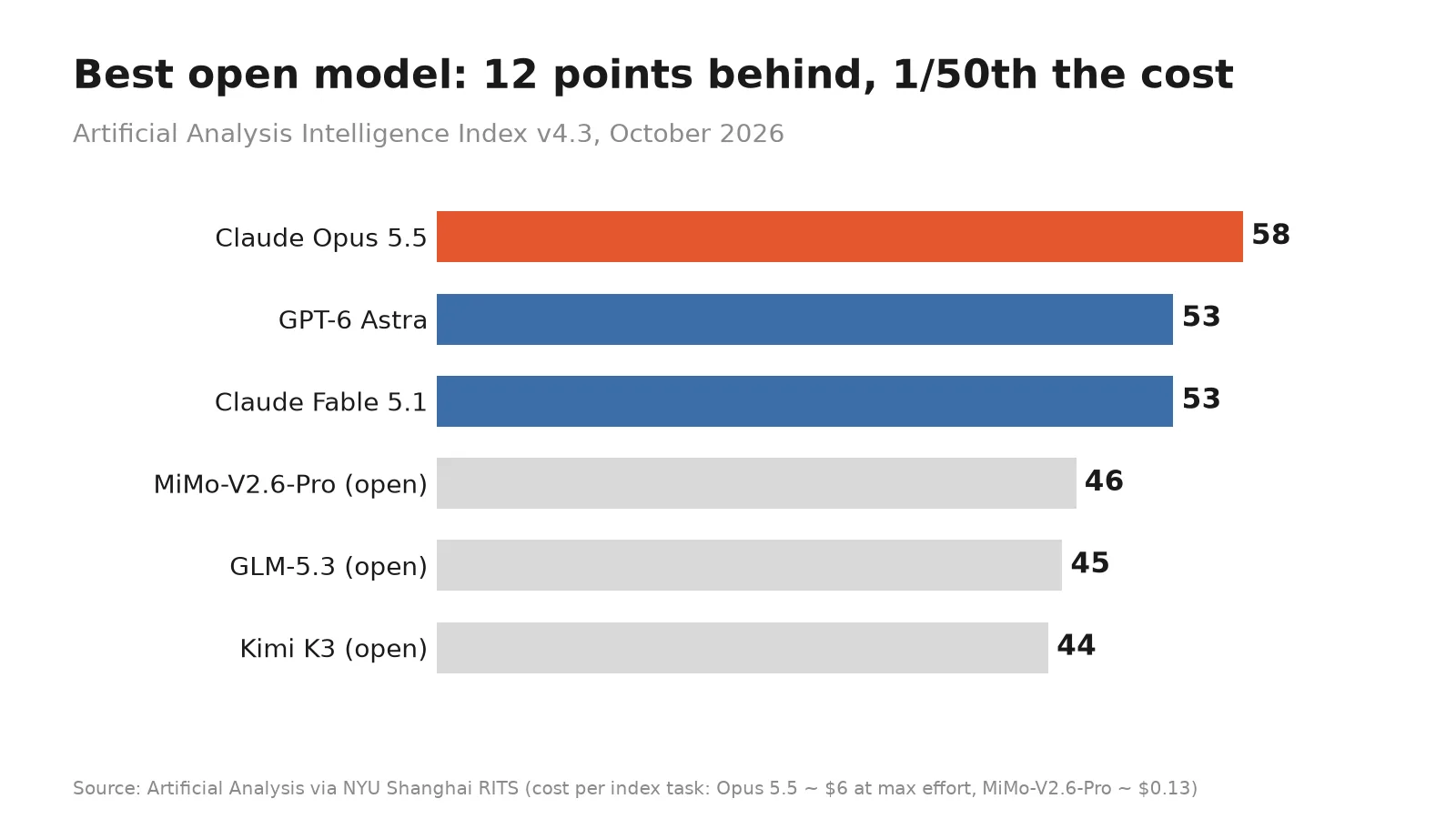
On the Artificial Analysis index, Claude Opus 5.5 scores 58. The best open-weight model, Xiaomi’s MiMo-V2.6-Pro, scores 46 and costs about $0.13 per task against Opus’s $6. Epoch AI puts the best open model an average of four months behind the best closed one. Opus 5.5 pulled ahead again in September, and if the pattern holds, the open models catch up within months.
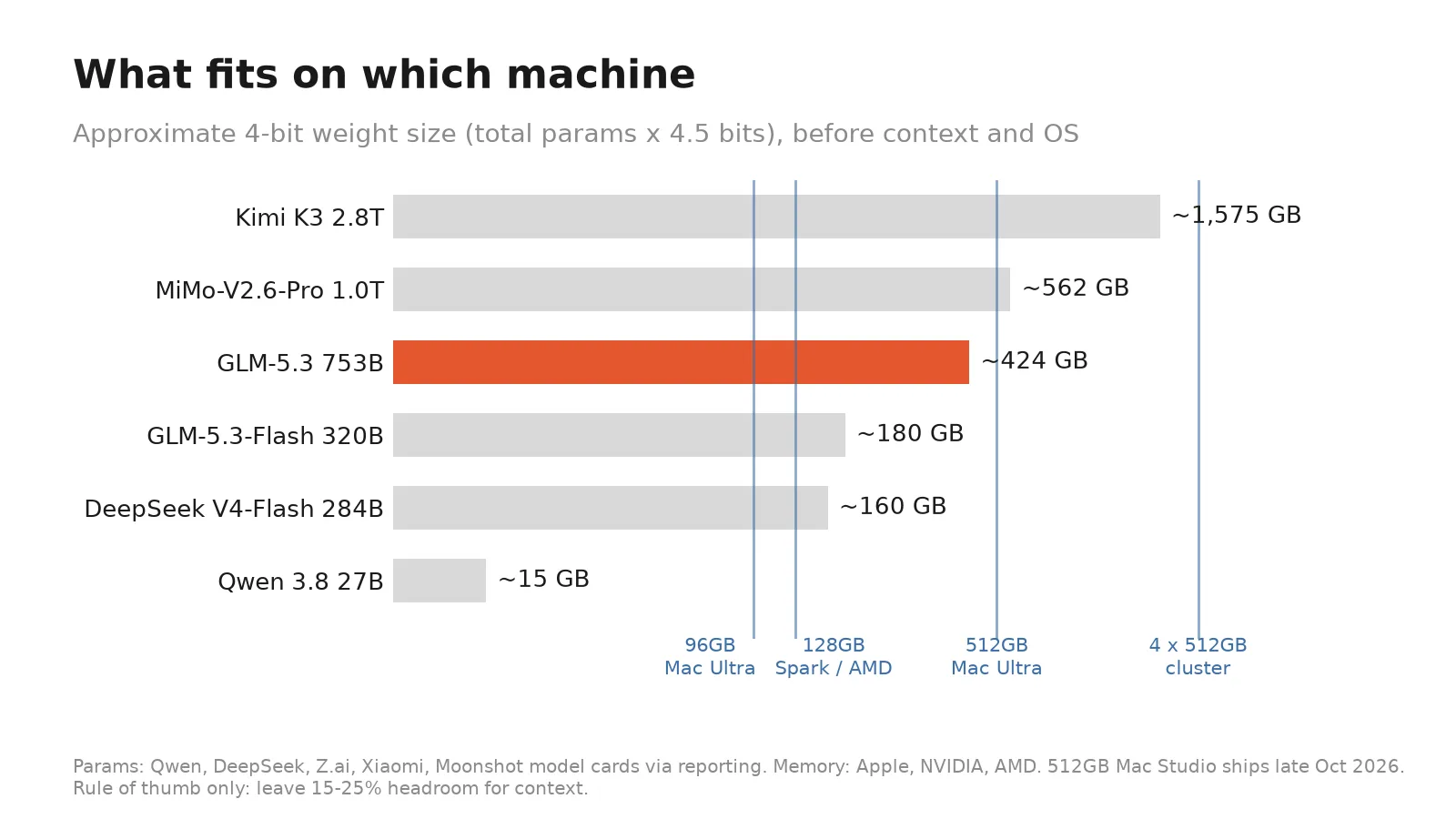
96 to 128GB: handles the 27B to 120B class comfortably.
256GB Mac Studio: the 160 to 180GB Flash models, DeepSeek V4-Flash and GLM-5.3-Flash.
512GB Mac Studio: GLM-5.3, the second-best open model on the index, just fits once that configuration ships later this month, as long as you raise the macOS GPU memory limit and keep contexts short.
Several machines: MiMo needs two of them and Kimi K3 needs four.
8-bit lands within a point of full precision on standard benchmarks, and 4-bit costs a few points, more on some models.
For the private-data crowd, that’s plenty for the boring, high-volume work most companies actually have:
Pulling fields out of documents and scans
Tagging and routing tickets and emails
Summarising and searching internal docs
Transcription and code completion
Long agent runs are still weak. Local models lose the thread after many turns, emit broken tool calls and write patches that don’t apply, and that’s the work I still send to Claude and Codex.
The setups that work route by task: narrow, high-volume work runs locally and hard reasoning goes to the frontier.
Fine, let’s talk about money: local LLM vs cloud API cost
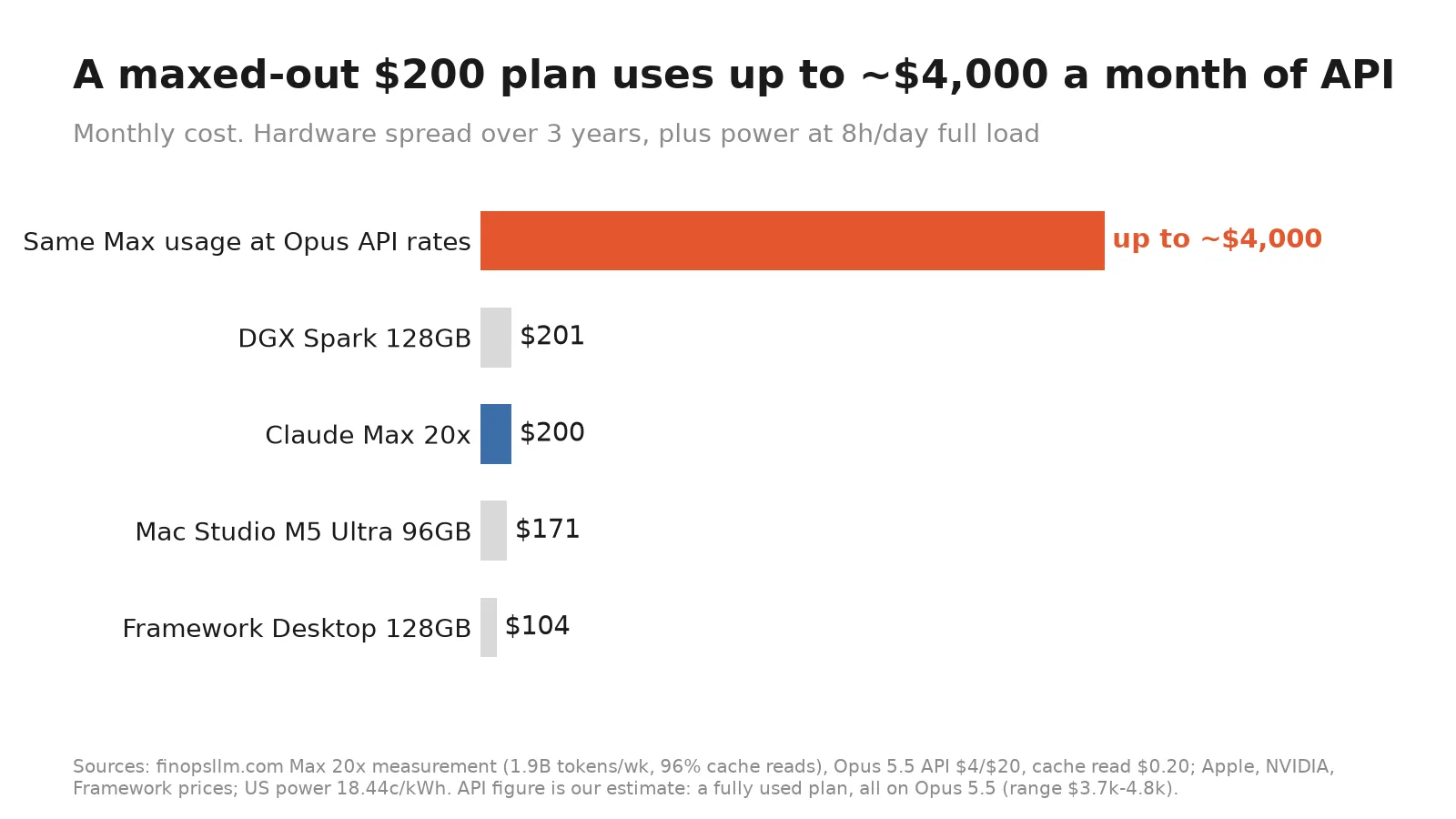
Since the replies insist. Renting is cheap right now because someone else is paying. By one team’s measurement, a maxed-out Max 20x plan moves about 1.9 billion tokens a week through Claude Code, 96% of them cache reads. At Opus 5.5’s API rates that’s as much as $4,000 a month if every token went to Opus. You pay $200.
Sam Altman, January 2025: OpenAI was losing money on the $200 ChatGPT Pro plan because “people use it much more than we expected.”
Subsidies end, and we’ve already watched it start:
Copilot moved to usage-based billing on 1 June 2026, and annual subscribers on the old plan watched Opus 4.6 go from a 3x to a 27x request multiplier overnight.
Cursor swapped request limits for compute credits in mid-2025.
Gemini 3.5 Flash launched at 5x the input price and 3.6x the output price of 2.5 Flash.
Owning isn’t free either. Spread over three years with power included:
Framework Desktop (128GB): about $104 a month
Mac Studio (96GB): about $171 a month
DGX Spark (128GB): about $201 a month
Memory shortages have pushed hardware up too, with the RTX Pro 6000 going from $8,565 at launch to $13,000–16,000 by August. And an idle box is the most expensive way to buy tokens. A June 2026 paper found self-hosting costs 2.5 to 24x more per token at low load than at full load.
So local only wins on price when the machine stays busy with batch jobs, steady pipelines or a team sharing one box. For everyone else the money is a side effect.
Where this goes
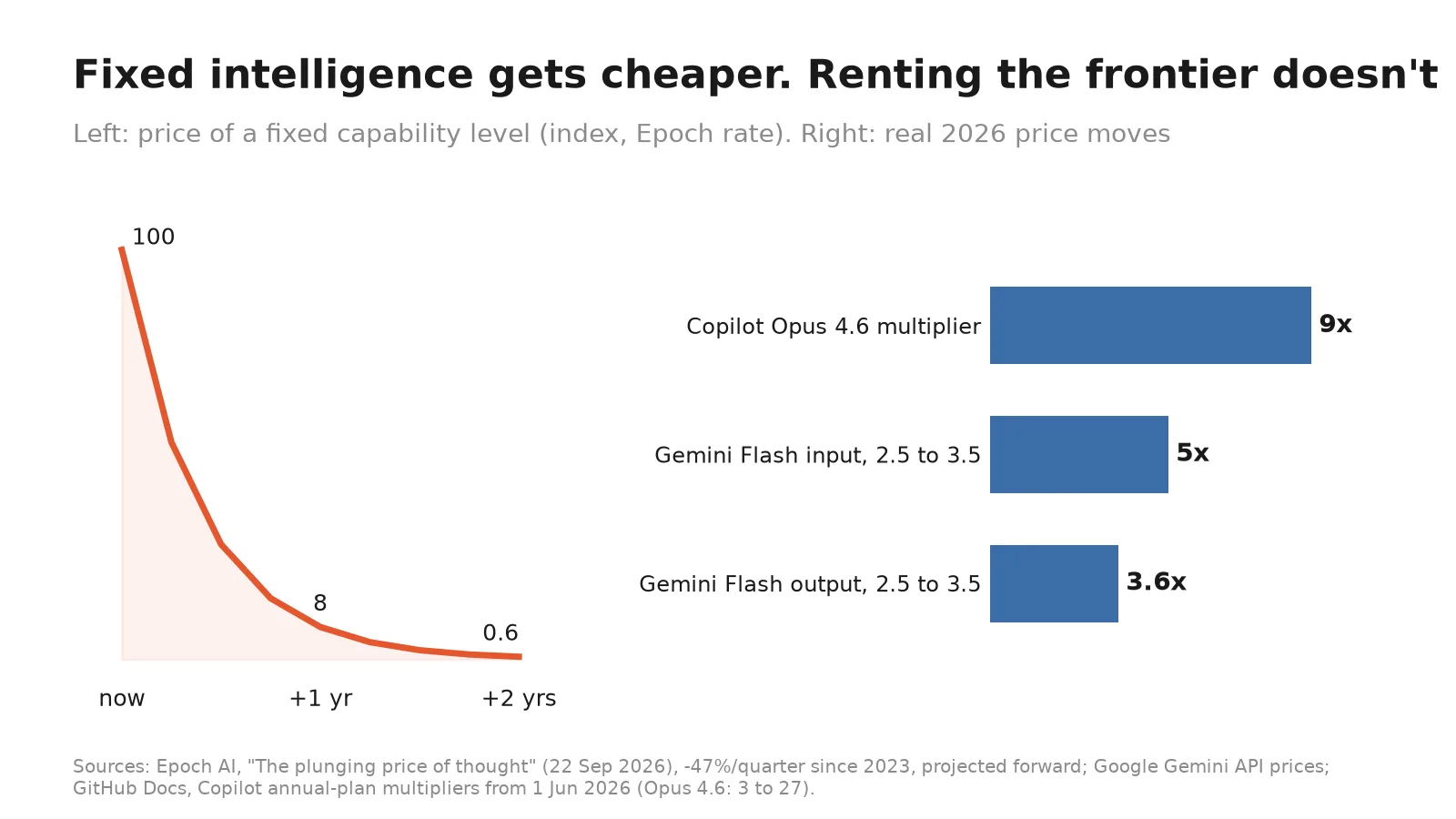
The cost of reaching a fixed level of capability has fallen about 47% a quarter since 2023, roughly 13x a year (Epoch AI).
The tinkerers get last year’s frontier on their desk, and the companies with locked-down data get a model good enough to do real work inside the building.
The 512GB Mac Studio ships later this month. If GLM-5.3 runs well on it, the second-best open model in the world fits on one desk, and the replies will still tell you to buy Claude Max.
FAQ: local LLM vs cloud API
Is a local LLM cheaper than a Claude or ChatGPT subscription?
Only when the machine stays busy with batch jobs, steady pipelines or a team sharing one box. Spread over three years with power included, a Framework Desktop (128GB) costs about $104 a month, a Mac Studio (96GB) about $171 and a DGX Spark (128GB) about $201, against $200 for a Max 20x plan. A June 2026 paper found self-hosting costs 2.5 to 24x more per token at low load than at full load.
Why run a local LLM at all?
For one of two reasons: you want to understand how inference works (quantisation, memory bandwidth, context and load), or you have data that isn’t allowed to leave, whether because of preservation orders, jurisdiction, regulation such as HIPAA and ITAR, or plain human error.
Are open-weight models good enough to replace a cloud API?
For narrow, high-volume work, yes: extracting fields from documents, tagging and routing tickets, summarising and searching internal docs, transcription and code completion. For long agent runs they are still weak, so the setups that work route by task and send hard reasoning to a frontier model.
How much memory do I need to run a local LLM?
At 4-bit weights, 96 to 128GB handles the 27B to 120B class, a 256GB Mac Studio runs the 160 to 180GB Flash models, and a 512GB Mac Studio just fits GLM-5.3. MiMo needs two machines and Kimi K3 needs four.
If your data can’t leave the building and you want AI working on it anyway, that’s the kind of system I help companies build. Reach out at hello@humza.io