I want you to imagine the scenario. You hand an agent a spec, you let it run for a week, everything compiles, the tests pass, and it still doesn’t do what you wanted. The code’s fine but your plan was broken from day one and nobody caught it because the only thing that ever reviewed it was the agent that wrote it. Yikes.
In my experience, projects rarely die in execution. They die in the planning, in the things you missed, especially the ones you don’t know you don’t know. And agents make it worse, honestly, because they’ll build on a bad plan faithfully, confidently and very, very fast.
I’m working on fine-tuning models that have to work out in the physical world, and agents write most of my specs regarding any operational tooling around it. So I wanted a way to poke holes in every spec until it stops breaking, then build. That’s the reason I’m writing this piece.
Never let the agent that wrote the plan be the one that signs it off.
Your agent can’t mark its own homework
I mean, you can loop it all day. Ask the same model to review its own spec and it reads it the way it wrote it, looking for reasons it’s right, right? Jie Huang and colleagues found in 2023 that LLMs “struggle to self-correct their responses without external feedback”. So you loop harder and you get the same plan back, just more confident about it. Lovely.
Here’s how I would do this: planning is a chain. Every step works off the last one and shapes the next. So the review cannot be one pass at the end; it has to be a loop where something with no stake in the plan keeps attacking it until it stops breaking.
Hone makes two agents fight over your spec
That loop is Hone, a small open-source framework I wrote. It’s on GitHub at github.com/humzakhan/hone, and the core of it is two roles taking turns.
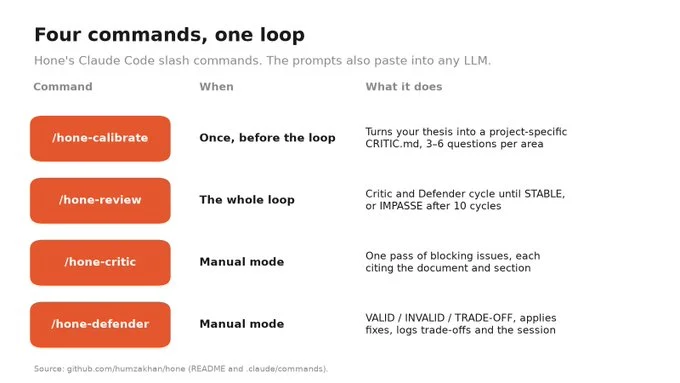
→ The Critic reads every doc and lists blocking issues only, each one specific, falsifiable and pinned to the exact document and section. No fixes, no praise, no “great start, love the vision!”.
→ The Defender rules on every single one. VALID, fix the docs right now. INVALID, show exactly where it’s already handled. TRADE-OFF, log it in KNOWN_TRADE_OFFS.md and move on.
Every fix is new surface area, so the Critic goes again. Zero blocking issues and the spec is STABLE, go build. Ten cycles and they’re still at it? It calls IMPASSE and hands you the open questions, because by then it’s a judgement call, and that one’s yours.
My favourite Defender rule is “A behavioural instruction is not a technical control.” If the only thing stopping a failure is a line in a prompt politely asking the agent not to, that’s VALID. Sorry.
The Critic, basically, is a disgruntled co-founder who’s a little tired of your shit. The Defender is you at 11pm, having to answer every single point.
Calibrate the critic or don’t bother
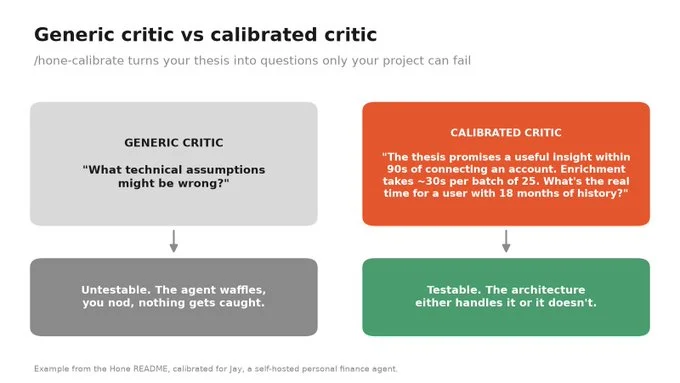
Point an off-the-shelf critic at your spec and you get “what technical assumptions might be wrong?” Thanks, very helpful. The agent waffles, you nod, nothing gets caught. It’s generic by design, and it works on principles that might not even apply to you, and you don’t even know, right?
So the first thing Hone does is /hone-calibrate. It reads your thesis and writes a CRITIC.md that’s specific to your project, with 3 to 6 questions for each of six areas, from core assumptions and failure modes to sequencing and the stuff that breaks in production with no one watching. Every question has to name something from your thesis and a specific way it fails, or it gets rewritten.
The example in the repo comes from Jay, the personal finance agent Hone grew out of. The thesis promises a useful insight within 90 seconds of connecting an account. Enrichment takes about 30 seconds per batch of 25. So what’s the real wait for someone with 18 months of history? Your architecture either survives that question or it doesn’t, and you find out on paper instead of in prod.
Run it on your next spec
Clone the repo and copy the commands into your project:
git clone <https://github.com/humzakhan/hone.git> /tmp/hone
cp -r /tmp/hone/.claude/commands/* .claude/commands/
cp -r /tmp/hone/prompts ./hone-prompts
/hone-review runs both roles in one session, which is quick. If you want them properly apart, run /hone-critic and /hone-defender by hand in fresh sessions. The Critic prompt says it has to come in cold, and I mean it. Not on Claude Code? The prompts are plain markdown, so paste them into whatever model you like.
Grab the next spec you’re about to hand an agent and let Hone tear it apart first. Much cheaper than hearing about it from your agents a week later.
Write thesis.md from the template. One falsifiable sentence for the core thesis, plus what the project is not.
Run /hone-calibrate to get your CRITIC.md.
Write architecture.md and implementation-plan.md.
Run /hone-review and let it go until STABLE or IMPASSE.
Read SESSION.md and KNOWN_TRADE_OFFS.md, so you know exactly what you’ve signed up for.
/hone-review runs both roles in one session, which is quick. If you want them properly apart, run /hone-critic and /hone-defender by hand in fresh sessions. The Critic prompt says it has to come in cold, and I mean it. Not on Claude Code? The prompts are plain markdown, so paste them into whatever model you like.
Grab the next spec you’re about to hand an agent and let Hone tear it apart first. Much cheaper than hearing about it from your agents a week later.
If you’re implementing AI in your company, or working out the hybrid of generic tools and the parts that have to be customized to how you actually work, that’s what I do. I might be able to help, so reach out at hello@humza.io and we’ll see if we’re a good fit to work together.